Tuesday, November 24, 2015

How to study your Bible (Part 2 of 5)- Determining the Context

        Now it is time to get into the COMA method of Bible study.  Context, Observation, Meaning, Application.  Today we are going to be looking at context.  Every passage in Scripture was written in a very specific context.  It was written by a specific person (inspired by God), living in a specific time, in a specific region, to a specific group of people living in a specific time, in a specific region, for a specific purpose.  In addition there is the context of the verse itself.  Unless it is the first verse in the chapter it has been preceded by other verses and chapters in the book, and there is the context of the whole Bible to take into consideration also.  Where does this verse, or section, fit in the entirety of Scripture?  What has come before, and what has come after?  There are lots of things to take into consideration when it comes to determining the context of the passage you are studying.
       
 Why does it matter?  

1.)   It matters because Scripture cannot mean something today that it did not mean when it was first written.  The objective in Bible study is to determine the original meaning of the passage and that is nearly impossible to do without understanding the context that the passage finds itself in.  

2.)  Much incorrect theology is the result of taking verses out of their context to say something that they did not say in their original context.  For example:  "I can do all things through Christ who strengthens me."  We use this verse to motivate us in our school work, our athletics, our exercise, when we face difficult challenges.  We use this verse at times to "Christianize" the America dream that I can do whatever I put my mind to.  However, in context the verses that come before this verse speak of Paul being content with much or with little.  So the "all things" that this verse is specifically applying to is the ability to be content in every and all circumstances through Christ who strengthens us.  Their are many more examples of this and it is is something that many of us (myself included) do from time to time.  I can honestly tell you that there have been times when I was planning on teaching a verse believing it taught one thing, and being really disappointed when I studied the context and determined that it really wasn't teaching what I wanted it to teach.  

3.)  Determining the context of a passage can bring more meaning and understanding to the passage of Scripture that you are studying.  There have been many times that in determining a context of a passage that I have been able to see the beautiful truths of God more clearly.  There have also been numerous times that determining the context of a passage have helped me to better understand the meaning of passages that seemed confusing or difficult initially. 

There are more reasons, but suffice it to say that determining the context of a passage is a vital part of studying the Bible.

How to determine the context of a passage?

The best way is to work through a list of good questions and answering them as much as possible.  While you can answer some of these from careful reading of the text there are also a number of these questions that you will need to rely on the help of a good study Bible or commentary.  So here are the questions to ask to help determine the context.  Several of these questions have been taken from the book, "One to One Bible Reading" by David Helm.

1.)  What sort of writing is this?  (Letter, narrative, poem, etc).

2.)  Who is the human author?

3.)  Who was it written to?  Where do they live?  What is their culture like, etc

4.)  What are the circumstances of those it was written to?

5.)  What has happened so far?

Those are some of the questions to ask that will help you determine the context.

Time to put it to practice.

Passage:  1 Peter 1:1-12.

Start with prayer and than read the passage (1 Peter 1:1-12)  and begin to ask the context questions to this passage and the book as a whole.  If you have time it would be helpful to read through the entire book of 1 Peter in your process of trying to determine the circumstances and setting that the recipients of the letter find themselves in.  If not, just stick with the one passage.  Would love for you to spend time working on this today and than comment below with the answer to some or all of the above questions.  Tomorrow, I will share what I discovered in working towards determining the context of 1 Peter 1:1-12 and the book as a whole before looking at Observation.  Praying for you as you spend time seeking to determine the context.  Let me know what questions you might have.

Monday, November 23, 2015

How to study your Bible (Part 1 of 5).


       Nothing has changed my life more than the Word of God.  Nothing.  I am not alone in this either. The people who have had the greatest impact on my life have all been people who consistently, and regularly spend time reading and studying the Bible.  I have read many biographies of brothers and sisters in Christ who have faithfully followed Jesus and a love for reading and studying the Word of God is a common theme amongst all of them.  If I could give people only one suggestion about how they can grow in their faith my answer would simply be, read and study the Bible regularly and consistently.  Read carefully what Hebrews 4:12 says about the word of God.  "The word of God is living and active, sharper than any two-edged sword, piercing to the division of soul and spirit, of joints and of marrow, and discerning the thoughts and intentions of the heart"  
       Most people who are followers of Jesus, and those who are exploring Christianity, know they should study the Bible.  However there seems to be a disconnect for many people between knowing what they should do and actually doing it.  Part of the reason for the disconnect is people simply not knowing how to study the Word of God.  Yesterday at Bethel we were looking at Mark 12:28-31, "And one of the Scribes came up and heard them disputing with one another, and seeing them he answered them well, asked him, 'Which commandment is the most important of all?'  Jesus answered, 'The most important is, Hear O Israel:  The Lord our God, the Lord is one.  And you shall love the Lord your God with all your heart and with all your soul and with all your mind and with all your strength.  The second is this:  You shall love your neighbor as yourself.  There is no greater commandment than these.'"  As we looked at loving God with our minds we focused in on the importance of studying the Word of God.  In hopes to help those who have never been taught how to study God's Word, or to simply provide a refresher for those who have fallen out of practice, over the next five days I will be walking us through one method of Bible study that you can use to dig into the Word of God. 
        Read carefully this passage from 2 Timothy 3:16-17, "All Scripture is breathed out by God and profitable for teaching, for reproof, for correction and for training in righteousness, that the man of God may be complete, equipped for every good work."  The Bible contains the very words of God, Scripture is breathed out by God, they come from Him, and it is the primary way that God has chosen to reveal Himself to us.  When we read the Bible we are actually reading the words of God.  Notice how these two verses ended... "that the man (and woman) of God may be compete, equipped for every good work."  That is how important the Bible is.  The Bible functions in our life for the purpose of making us complete and equipped for every good work. Everything we need to know about God, ourselves, Jesus, faith, and following Him are in the Bible.  Do you want to grow in your faith?  Be in the Bible.  Do you want to love God more?  Be in the Bible.  Do you want to know how to treat others?  Be in the Bible.  Do you want to trust God more?  Be in the Bible.  Do you want to know God more?  Be in the Bible.  Do you want to know the Holy Spirit more?  Be in the Bible.  Do you want to better understand grace?  Be in the Bible.  Do you want to know how to fight sin and temptation?  Be in the Bible.  My hope for you, my prayer for you, is that in the coming days, weeks, and month you would come to drink regularly from the Words of God and through that you would see yourself becoming complete and equipped for every good work.  
       The path ahead.  We are going to be looking at the COMA method of Bible study (terrible name, I know) over the next four days.  In this method we will begin to learn how to determine the Context of the text, make Observations about the text, determine the Meaning of the text, and Apply it to our daily lives.  For each of the next four days we will explore each of these one day at a time.  In addition, we will be studying through a specific text together.  So tomorrow we will explore how to determine the context of a passage and you will be given a passage to begin applying what you are learning about determining the context of a passage. 
       I hope you will join us this week as together we look at how to study the Bible.  

Tuesday, June 23, 2015

Ballons Pop

       Balloons!  The joy and laughter that can fill a child at the sight of balloons is remarkable!  Big ones, small one's, ones shaped like hats, hearts, ninja turtles, swords, water filled balloons, or the simple round balloon!  A couple weeks ago had the opportunity to go with my kids to see "Mr. Twister:  The Balloon Guy!"  Leaving the show with a balloon hat brought joy and excitement to all five of my kids that within 60 seconds came crumbling down for one of them.  As Ty, my three year old, was walking back to the van filled with joy and excitement playing with his balloon hat he accidentally rubbed it agains the brick exterior of the building and POP!  Every parent knows what is coming next...  Yep, the tears!  The passionate tears of sadness and disappointment combined with a three year old who was quickly approaching his nap time resulted in a couple minutes of an inconsolable little boy whose balloon popped.  While life eventually moved on and his balloon was eventually forgotten about and the rest of the balloons popped, deflated, or were simply forgotten about as they moved onto the next big thing I was struck with the thought of how foolish it is to put one's hope and joy in a balloon.  They are fickle, they are temporary, they face numerous dangers, and they are guaranteed to not last forever.  They pop, they deflate, they can float off into the sky when the string slips through a child's hand, they are popped or destroyed by others.  It is foolish to put our hope and joy in balloons but I wonder how many balloons you and I put our hope and joy in.  Not literal balloons, but none the less things that like balloons prove to be temporary, fickle, guaranteed not to last, are surrounded by numerous dangers, any one of which could make them go "POP" and so goes our hope and joy.  
       What is your hope and joy in today?  What is my hope and joy in today?  It is futile to put our hope and joy in balloons.  So let's stop doing that.  Instead let's fix our hope and joy on Jesus Christ alone.  Our only Hope.  Our Only Joy.  Our Only Guaranteed to never die HOPE and JOY that we have is in Jesus Christ.  Praying the prayer that Paul prayed for the believers in Ephesus for you and me.... Ephesians 1:18, "Having your hearts enlightened, that you may know what is the HOPE to which he has called you, what are the riches of his glorious inheritance in the saints, and what is the immeasurable greatness of his power toward us who believe, according to the working of His great."  Balloons pop-  Let's stop putting our hope and joy in them.

Thursday, June 4, 2015

Stop trying to change the world!

       Change the world.
       Leave a mark.
       Leave a legacy.
       Make A difference.
       Be a World Changer.
       Be a history maker.
       Make your life count.
       Make a lasting impression
       Be the generation that changes things.
       Change a life
       Rescue a life
       End poverty
       End sex trafficking
       End domestic abuse
       End _______________

   
       It all sounds good doesn't it.  It all sounds really, really, good, and it speaks to us at a deep level.  We want to change the world, we want to leave a mark, we want to be a history maker, we want to be a part of ending slavery, poverty, sex trafficking, domestic abuse.  Who wouldn't want to be apart of providing homes for orphaned kids all across the globe.  All of the rhetoric above seems to be common place within western evangelical Christianity and especially in ministry towards youth and young adults.  I have used the above phrases numerous times with various groups of people.  I have taken students on multiple short term mission trips with a great organization called, "World Changers" where the first day of the trip we learn the theme song...
"You can be a world changer.
Shinning your light for those in danger.
Sharing the love of our Lord and Savior.
You can change the world.
Go out and change the world."
       However, the more I think about this common rhetoric the more I see several dangers.
First, it is easy to picture ourselves as the hero, the godsend, the rescuer, the one who is going to sweep in and save the day.  As that thinking seeps into our minds we lose sight of the Gospel, we lose sight of Jesus, we lose sight of the Biblical truth that we are not the hero's, the godsends, the rescuers.  Instead we are the ones who need a hero, who need a godsend, who need to be rescued and Jesus alone is the God-send, the hero, the rescuer who swept in and saved the day.  As we forget who the only hero is we tend to over-emphasize our ability to make a change and under emphasize our desperate need upon God to change people's lives.
        Secondly, the above language has the ability to downplay the importance of everyday faithfulness to God in the mundane, routine, ordinary tasks of life.  The vast majority of our lives our not lived in the "world changing, history making, ending sex trafficking realm."  The vast majority of our lives are spent in the ordinary tasks of life.  You will spend countless hours at work during your life and most people cannot easily connect how their day to day work is "world changing" in our common understanding of the phrase.  However, if we understand that we have not been called to be world changers but instead we have been called to be faithful it changes how we go about work.  Faithfulness to God in work comes through doing our work in order to serve and bring glory to God, and doing our work to serve our neighbors.  This shift from "world changer" to faithfully following Christ not only applies to work but to every area of life.  It applies to marriage, parenting, being a neighbor, and being apart of the local body of believers.  It applies to mowing, doing laundry, making dinner, changing diapers, and washing dishes.  We must be careful to not speak in such a way that the vast majority of our life is seen as unimportant, because in every area of our life God desires us to be faithful to Him, to serve Him, and to bring glory to Him.  It is also in the mundane areas of life that God desires to use to make us more and more into the image of His Son Jesus Christ.  If we don't emphasize faithfulness to God in all of life we will send countless people running from "high to high" of Christian world changing activities and all the while missing out on the countless daily opportunities to bring glory to God when we are faithful in the small, ordinary, mundane things in life.
       Lastly, the above language undermines what we have been most called to.... and that is to know Jesus Christ.  We have been called to a relationship with Jesus Christ.  We have been called to know Him, Love Him, to be like Him.  Our calling first and foremost is to a person, it is to a relationship, it is to our savior Jesus Christ.  That is our calling first and foremost to Jesus and everything we are called to be and do is the result of that relationship.  We are called to be salt and light but our salt and light is a result of us being in a relationship with Jesus.
        We are not called to change the world.... we are called to a relationship with Jesus Christ.  To love Him, to serve Him, to bring glory to Him.  We are called to be faithful.  We are called to love our neighbor.  As you pursue Christ, as you bring glory to Him, as you serve Him, as you strive for faithfulness in the big and the small, and as you love your neighbor you just might find the world around you changing because you are in a relationship with the one who changes people's world.

Wednesday, February 25, 2015

Not even sure what title to give this one....

       A while back on a Sunday evening I was sitting in my comfortable recliner, in my comfortable house, scrolling through my twitter feed on my iPhone 5 when the news of 21 Christians being beheaded comes across the feed and as I read more and learn more about what happened I was saddened, I was hurt, I was broken-hearted for what had happened, and I prayed...
      Than an hour later I was eating a DQ blizzard in my comfortable recliner, in my comfortable house, with my wife and my parents.  The next day my life goes on filled with comforts and relative ease.  It doesn't seem right.  It seems shallow.  It seems costless.  It seems unfair.  Where is my persecution?  Where are the ones who are going to hate me?  Where is my cost?  Where is my sacrifice?  How do I harmonize that my brothers and sisters in Christ are being martyred, beheaded, persecuted, and hated around the world, and I am eating a blizzard?  Saying a quick prayer for my persecuted brothers and sisters seems shallow, giving 10% of my absurd amount of wealth seems shallow, being a nice person and maybe occasionally sharing Jesus seems shallow.  All the phrases and quotes that those of us who are Christians in America who are privileged, filthy rich, and have filled our lives with comfort and entertainment, seem offensive.  
       I'm restless.  I'm confused.  I'm processing.  I'm divided.  I'm torn.  I'm discontent.

Wednesday, February 11, 2015

What Taco John's can teach the church

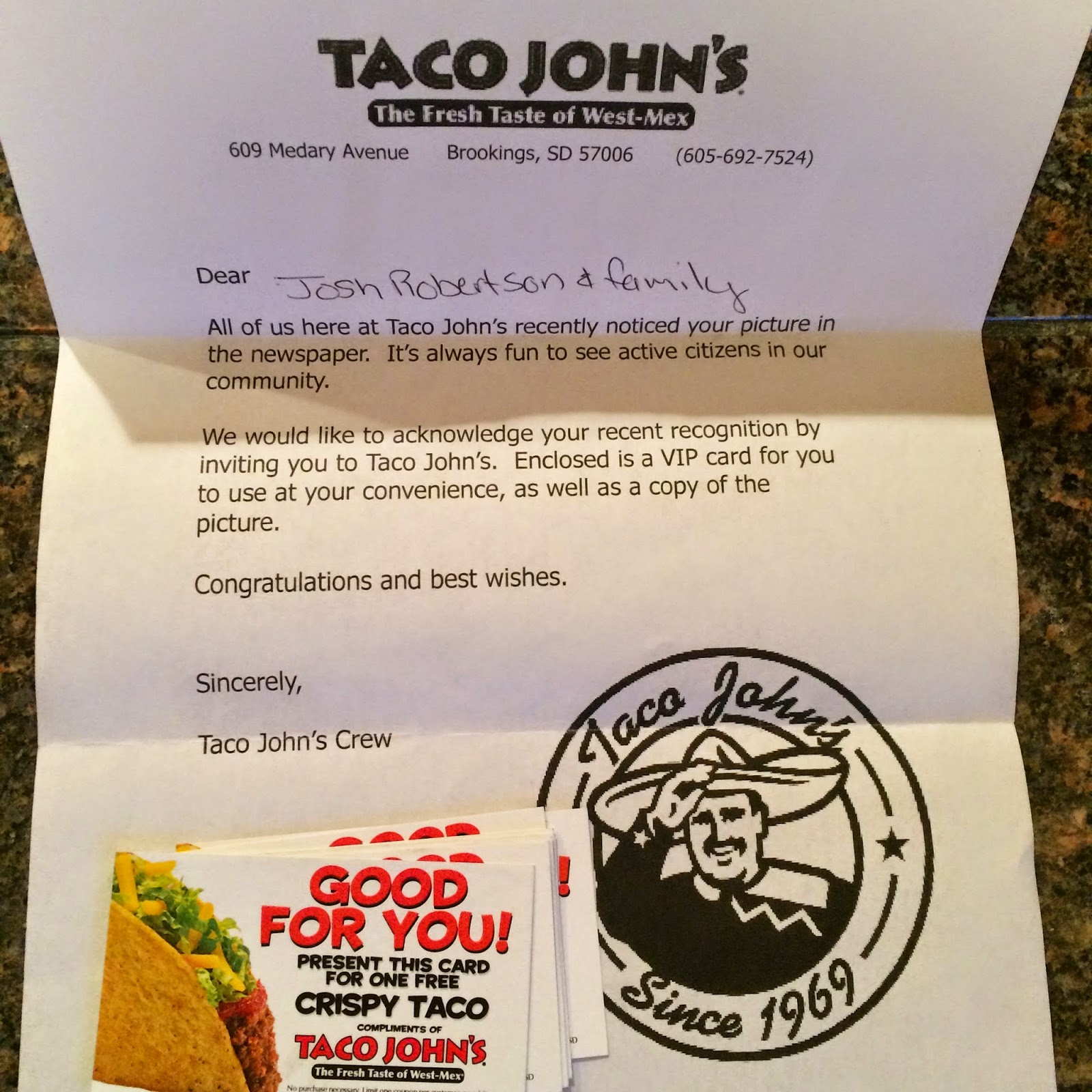
           Last Thursday an article and picture were put in the local paper here in Brookings, SD introducing myself as the new pastor at Bethel Baptist Church and inviting the community to the installation service this past Sunday.  When I came to work on Tuesday I found an envelope in my box from Taco Johns, and here is what was in it...


             It was simple.  It wasn't elaborate.  It wasn't extremely costly or difficult.  In spite of that.... it left a really good impression (and soon to be a yummy impression too!) Sometimes we get too caught up in wanting to do "big" things for God and miss out on countless daily opportunities to do things that are simple and easy BUT leave a good impression!  Yes, we will be called as followers of Christ to also do hard things where we must deny ourselves, take up our cross, and follow but let us not miss out on the everyday opportunities to leave a really good impression.  Are we so focused on trying to hit a home run that we miss out on opportunities to lay down a bunt and advance the runner?  Our Gospel proclamation can never be only "good deeds" but our good deeds should be plentiful as we strive to leave good impressions that will make speaking the Gospel in our communities more impactful!
             What can you do in your neighborhood, work-place, local store, and community in order to leave a really good impression of the Gospel?  Now go do it!  


Monday, May 19, 2014

Gospel and loving our enemies

       As we continue to look at how knowing, grasping, and cherishing the Gospel helps us to live out the life Jesus calls us to live we are going to look at the command to love our enemies.  Matthew 5:43-44, "You have heard that it was said, 'You shall love your neighbors and hate your enemy.'  But I say to you, Love your enemies and pray for those who persecute you."  We are commanded by Jesus to love our enemies and pray for those who persecute us.  That kind of love is not our natural response.  We don't naturally love our enemies.  We don't naturally pray for those who persecute us, but that is what Jesus is calling His followers to do.  
       How does knowing, grasping, and cherishing the Gospel help us to love our enemies?  The Gospel tells us that because of our sin we are God's enemies.  Romans 5:10, "For if while we were enemies we were reconciled to God by the death of Son, much more, now that we are reconciled shall we be saved by his life."  Do you see what Paul is saying here?  He is talking to Christians and reminding them that before they were reconciled to God they were enemies of God.  That doesn't get talked about a lot today.  It doesn't feel very good to be told that unless we have put our faith in Jesus we are actually enemies of God.  However, that is what the Gospel proclaims. It proclaims that we who were once enemies have been reconciled to God by Jesus and that is GOOD news!  We like to think that before Jesus we were pretty good people, but that is not what the Bible says.  The Bible says that we were enemies with God and anyone who is an enemy of the God of the universe is not a pretty good person.  That is a person who is in desperate need to be restored and reconciled to God and that is exactly what Jesus did when He took the punishment, death, and wrath upon Himself that you and I deserved because we were the ones who were God's enemies, not Jesus.  
       Friend, that is the Gospel and that is indeed God news.  Do you see how this connects to loving our enemies?  The Gospel shows us how the God of the universe was able to love and reconcile us while we were His enemies and that should be our motivation for loving our enemies.  Loving our enemies is doing exactly what God did for us.  The more we realize the desperate state that we were in before Jesus the more willing we will be to offer that same kind of love, grace, and mercy to others that God offered to us.  You don't have the capacity to love this way in and of yourself but that is exactly why God gave us the Holy Spirit so that we would have God's love dwelling within to give to others.  Knowing, grasping, and cherishing the Gospel helps us to love our enemies.